

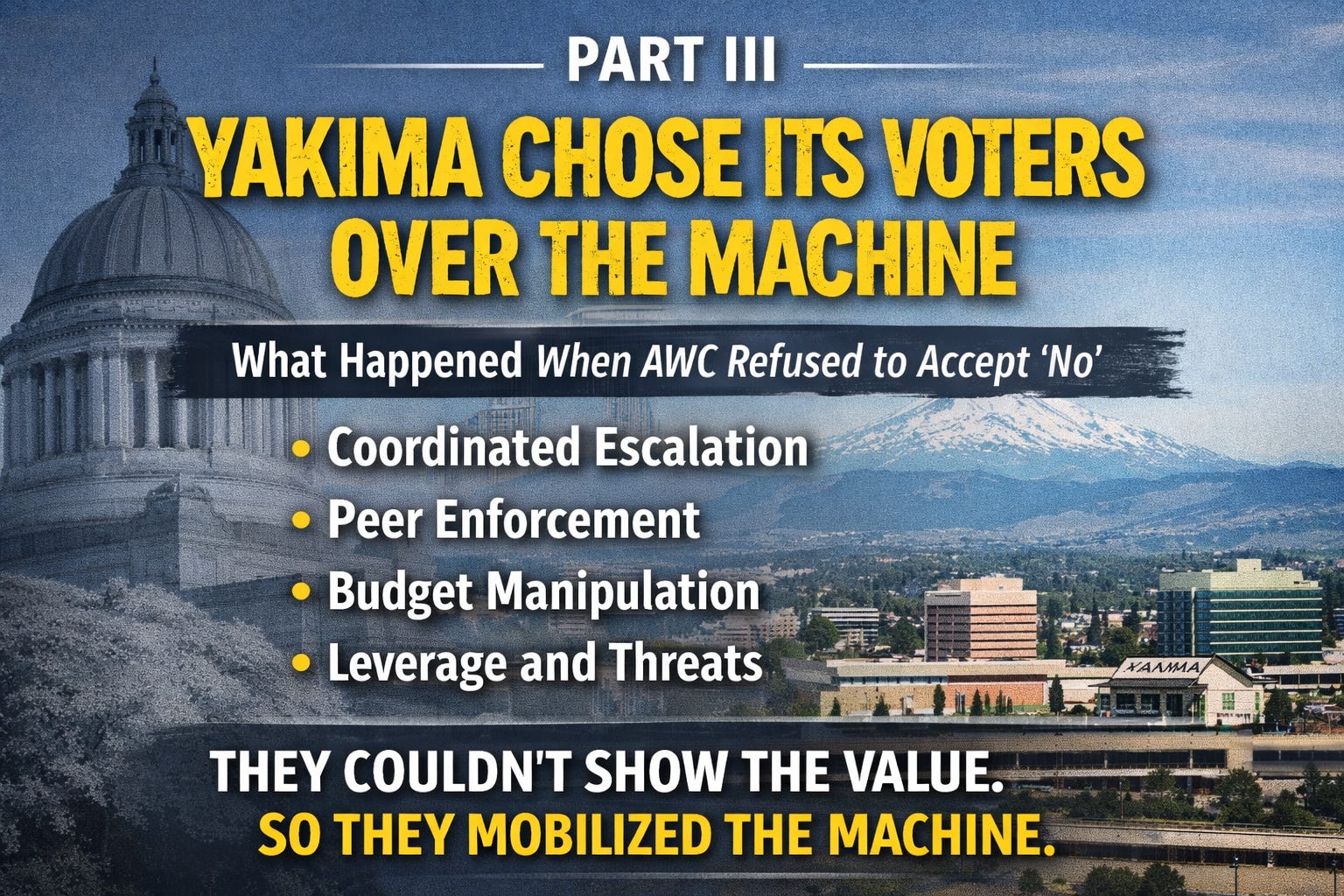
How the Machine Responded When Yakima Said No
Part 2 laid out the policy reality. How the Association of Washington Cities consistently claims legislative “wins” that align with progressive priorities, centralize authority in Olympia, and shift costs and consequences onto eastern Washington communities.
Part 3 is about what happens when a city stops playing along.
Because the moment Yakima chose to leave the Association of Washington Cities, the abstract became personal. The theory became practice. And the response from the system revealed far more than any policy position ever could.
Yakima Did Not Drift Away. It Voted Its Way Out.
Yakima’s decision to leave AWC was not casual, accidental, or symbolic.
It happened twice.
That matters, because institutions will forgive a moment of weakness. They do not forgive persistence.
In July, the Yakima City Council voted 7–0 to terminate the city’s membership. Unanimous. Clear. No ambiguity. Councilmembers were staring at real financial constraints and doing what elected officials are supposed to do.
They weighed priorities.
Is this more important than a park?
Is this more important than a police officer?
Is this more important than a firefighter?
For me, the answer is always no.
City government exists to deliver core services. Associations do not outrank public safety, infrastructure, or quality of life. That principle guided the July vote.
That should have ended the matter.
It did not.
The Machine Does Not Accept “No” Easily
Once Yakima said goodbye, the response was immediate and coordinated.
It did not begin with confrontation. It began with emails.
They came from AWC directly. They came from people adjacent to the AWC ecosystem. They came from other membership-based organizations whose influence flows through the same professional channels.
Every message was polite. Every message was framed as concern, clarification, or assistance. But the message beneath them all was the same.
This decision needed to be revisited.
Leaving was not treated as a normal governance choice. It was not respected as a budget prioritization. It was treated as a deviation from accepted behavior, a problem to be solved, an error to be corrected.
What stood out was not just the emails and letters, but the sameness. Yakima was told it misunderstood the value. That it was isolating itself. That it was acting irresponsibly. That remaining inside the system was the adult, professional choice.
Then the escalation came.
Leadership intervened. The president of AWC personally emailed councilmembers. At that moment, a local budget decision had been elevated into an institutional crisis.
The implication was unmistakable.
Yakima was not just leaving. Yakima was breaking a rule.
Pressure Did Not Stay Inside AWC
The pressure soon extended beyond the AWC itself.
Emails and letters arrived from other local and regional organizations that benefit, directly or indirectly, from Yakima’s continued place within the broader association ecosystem. Among them was correspondence from tourism promotion leaders, including a notable letter from John Cooper that warned of potential economic fallout and damaged relationships.
The conversation changed course.
It was no longer centered on whether the AWC actually delivered sufficient value to Yakima. Instead, it turned to questions of alignment, public perception, and the risks of what the city might forfeit by proceeding.
At no point did anyone offer a simple acknowledgment: “We disagree, but we respect your local decision.”
That silence speaks volumes.
If membership were genuinely voluntary and rooted in clear, demonstrated value, the reaction would have been straightforward acceptance, perhaps mild disappointment, followed by moving forward. Organizations truly secure in their worth do not launch coordinated pressure efforts when a member chooses to leave.
What Yakima encountered felt entirely different.
It felt like an exercise in containment.
Peer Pressure Is How the System Enforces Itself
The most intense pressure did not arrive through emails or public letters. It came directly from peers.
At trainings, conferences, and professional gatherings, Yakima’s decision to leave the AWC was never treated as a neutral choice. Conversations grew cooler. Tones shifted. The unspoken message hung in the air: opting out was not merely different. It was wrong.
The analogy is straightforward.
Withdrawing from the AWC felt like canceling a Costco membership while standing in a room full of devoted Costco shoppers. You did not simply conclude it held no value for you. You challenged the very premise. You suggested the bulk savings might not be essential. You implied the exclusive perks could be overstated.
That kind of questioning unsettles people.
In certain circles, the decision was framed less as a legitimate policy difference and more as a breach of professional etiquette. It bordered on a moral lapse. This reaction was no accident.
It was a form of quiet enforcement.
Associations Are Not Just Services. They Are Identity.
There is an uncomfortable truth embedded in the heart of government institutions.
For many public sector professionals, associations like the AWC are far more than practical tools. They form a core part of professional identity.
They supply a shared language, a common set of assumptions, and a collective stamp of legitimacy. Active participation comes to define true professionalism. Simple membership signals seriousness and commitment.
Stepping away disrupts that carefully constructed narrative.
If one city can withdraw and continue to thrive without it, a profoundly unsettling question emerges: What does that reveal about the true necessity of the entire structure?
That question poses a far greater threat than any individual membership vote ever could.
The Second Vote Came Back Through Process, Not Policy
In November, the issue resurfaced. Not because the council asked for reconsideration. A councilmember, with staff guidance, attempted to reintroduce AWC membership through a different budget mechanism, outside of the general fund.
This was staff attempting to keep the membership alive by using bureaucratic maneuvering. The goal was simple: move the expense into other budgets to reduce visibility and remove budgetary pressure from councilmembers. If the membership no longer lived in the general fund, it no longer had to compete directly with parks, police, fire, or basic services.
The intent was obvious.
By shifting the cost, the decision could be made less painful for councilmembers focused on budget concerns. The tradeoffs would be blurred. The scrutiny would be reduced. The membership could survive quietly. It is comical how often councilmembers across the state fail to recognize how consistently they are being influenced by people who are not their constituents. Yakima’s council ultimately decided to buck that trend.
This was not conspiracy. It was institutional instinct. When an institution loses a policy fight, it turns to procedure. When it loses visibility, it seeks obscurity. When it cannot justify value, it relies on process.
The council voted again.
This time, 5–2.
AWC membership was terminated for a second time.
The attempt failed.
But the attempt itself revealed something important. It exposed just how deeply the system resists exit, and how far it will go to preserve itself once challenged.
“It’s Not That Much Money” Is How Bad Spending Survives
One common defense emerged time and again: “It’s not that much money in the grand scheme of things.”
That single phrase reveals everything. When an expenditure cannot be justified by its clear value, measurable outcomes, or direct alignment with public representation, it is instead downplayed as trivial. Too small to scrutinize. Inexpensive enough to retain indefinitely. Familiar enough to protect without question.
This is precisely how bureaucratic creep takes hold.
For some, AWC membership resembled a Costco bulk subscription for city staff: access to training sessions, conferences, professional networking, and that subtle sense of belonging.
But city government is not designed to fund staff perks or institutional comforts.
It exists solely to deliver essential services to the people it serves.
When “Economic Impact” Becomes a Pressure Tactic
As resistance persisted, another argument appeared. AWC claimed Yakima should maintain membership because its annual conference brings economic benefit. Three hundred to five hundred attendees. Roughly $400,000 in gross economic activity.
That sounds impressive until you apply even basic scrutiny.
Gross economic activity is not revenue to the City of Yakima. Most of that money goes to hotels, restaurants, transportation, and incidentals. The city captures only a fraction through sales and lodging taxes. That fraction does not offset the cost of membership.
More importantly, nothing prevents AWC from holding its conference in Yakima regardless of membership status. Yakima’s convention center is among the most affordable in the state. That is why organizations choose it. If AWC wants to host its conference here because it makes financial sense, it still can.
AWC chose to condition the conference on membership.
That was their decision. Yakima did not revoke an invitation. Yakima did not raise prices. Yakima did not restrict access. Yakima simply declined to fund a membership it no longer found valuable.
At that point, the argument stopped being about economics and became about leverage.
Pay the membership, or lose the conference.
That is not partnership.
That is pressure.
What Actual Benefit Was Ever Proven
Throughout this entire debate, one crucial question remains unanswered: What tangible, documented benefit truly compels Yakima to remain a member?
Insurance? Yakima is already self-insured, and no quote was ever provided to demonstrate that pooling would yield any savings.
Legal services? Yakima maintains its own full legal department, while the free statewide resource of MRSC stands readily available to all.
Training? It may be helpful, yet it is far from indispensable, and certainly not worth diverting resources from our community’s core priorities.
No direct, apples-to-apples comparison was offered. No quantifiable savings were identified. No essential capability was shown that Yakima currently lacks.
In the end, what persists is mere habit, familiar comfort, and the weight of institutional expectations.
That is not a genuine need.
That is simply inertia.
Who Do You Answer To
At the end of the day, every city councilmember must confront a single, defining question: Who do you truly answer to? The board of the AWC, or the voters who entrusted you with their voice?
I can only speak for myself: I serve the voters, first and foremost.
Deep down, I believe most councilmembers feel the same, even as the system subtly pulls them in the opposite direction. Organizations like the AWC flourish by fostering a culture of conformity: the notion that belonging is essential for legitimacy, that true professionalism demands unwavering participation, and that daring to step away brands you as irresponsible or rogue.
This is how the invisible box is constructed. One subtle layer at a time. Membership becomes the default norm. Active involvement turns into an unspoken obligation. And any form of dissent? It’s swiftly labeled as dangerous deviation.
Yet Yakima chose to shatter that box. Not out of disdain for collaboration, nor a rejection of valuable expertise. Far from it. We did so because no external organization, no matter how established, holds greater authority than the people who call this city home.
City councils aren’t formed to safeguard associations or uphold institutional traditions. They exist for one purpose: to amplify the voices of their communities, unfiltered and uncompromised.
Where This Goes Next
Part 2 exposed the policy outcomes.
Part 3 exposed the pressure, the process, and the institutional response to dissent.
That leaves one final claim.
The benefits AWC insists justify it all.
In Part 4, we will examine those claims one by one. Insurance. Legal services. Training. Advocacy. Influence.
Not with tradition. Not with assumptions.
If the value is real, it should survive scrutiny.
If it does not, cities deserve to know that too.
Thanks for educating us. Why would any city east of the Cascades choose to be a member is the question. I hope the Tri-Cities follows suit!
This is so educational! I had no idea. Can't wait for part 4.